Most farmers have heard enough about carbon credits to be wary of them. And fair enough. When carbon becomes the main driver of land use, we see whole farms planted into pine and decisions that don’t reflect good farming practice.
The question is: “Can carbon credits actually improve the farming system, rather than replacing it?”
The short answer: Yes, if used carefully, and aligned with good land management.
Farmers are already doing the work
Across the region, farmers are fencing and planting waterways, planting shelter, stabilising steep faces, and trying to leave the land in better shape for the next generation
Carbon credits will never replace good land management, but they can help pay for it.
A Tool, Not a Solution
The Emissions Trading Scheme (ETS) is not a silver bullet and is far from perfect. But like any tool, if you understand what it can and cannot do, you can use it safely.
We operate under a simple rule:
“Don’t plant anything you wouldn’t be happy with if the ETS disappeared tomorrow.”
If the carbon price drops to zero, your farm should still be in better shape than when you started.
This means not planting productive land. Focus on natives that improve biodiversity and water quality. Use exotics sparsely and intentionally.
If used cleverly, carbon credits can pay for the environmental work you want or need to do. We call this concept the “Carbon Bank”.

The Carbon Bank
The "Carbon Bank" approach is about establishing a small area of forest in the ETS (This could be new planting, or forest you already have), registering the forest to generate cash flow, then reinvesting that money back into the land.
Instead of relying on grants that might dry up, you create a perpetual restoration fund to pay for riparian planting, fencing, or erosion control. As more areas of the farm are restored, the carbon returns compound.
A Real Example
One recent client had 16 hectares of existing native forest tucked away in gullies across the farm.
Option 1: Cash Out Register the 16 ha, claim the credits, and pocket the income.
Option 2: Carbon Bank Register the 16 ha and use the carbon income to fund another 20 ha of native planting over the next eight years in riparian and erosion-prone areas.
Here’s what happens to their cumulative net return over time:
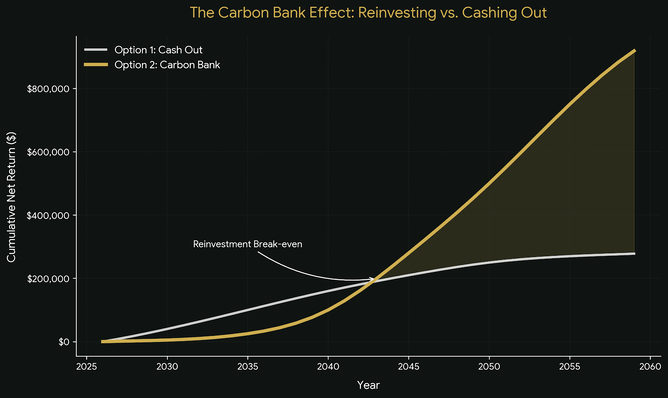
By using the Carbon Bank model, the asset base will be significantly larger by 2050. They gain 20 hectares of new native forest, improved water quality, biodiversity and shelter for stock. All funded without off-farm capital.
It’s About Viability
We know that for most families the top priorities are about financial viability, keeping the family on the land, and improving water quality and biodiversity.
Carbon credits aren't going to save the world, but they might help keep the farm viable.
If you have areas of regen, native planting, or forest on your property, you might be sitting on a "Carbon Bank" that could fund the improvements you’ve been meaning to get to.
Where to Start
Wai Kokopu Society has funded 10 ETS eligibility assessments for farmers in the catchment. We’ve already completed the first five, and the results have been encouraging:
Here’s a quick snapshot of what we’ve found so far:
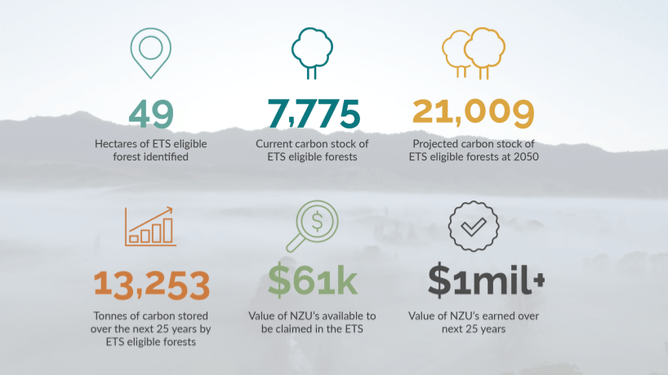
Those five properties alone had meaningful areas of eligible forest, solid projected returns, and most importantly, a picture of how carbon could support the environmental work they were already doing.
The remaining five funded assessments are now open to anyone in the catchment who wants to understand the carbon opportunity on their property.
It’s free, and it’s first in, first served.